ASP.NET Core API Security: Authentication Is Only the Beginning (.NET 9 Guide)
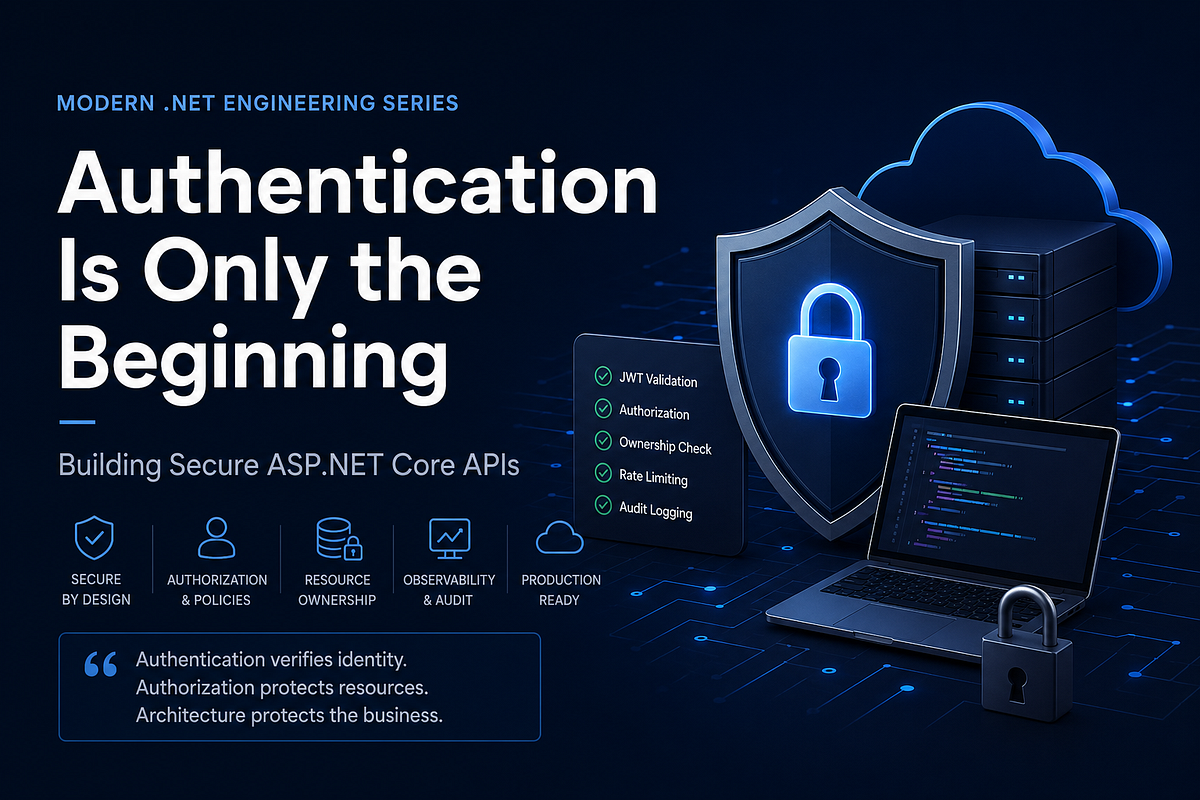
JWT authentication is only the first step. This guide shows how to design ASP.NET Core APIs where authorization, ownership checks, secrets, audit logging, and observability work together in production.
Authentication Is Not a Security Architecture
A system that authenticates a request has answered one question: who is calling, according to a trusted authority, right now.
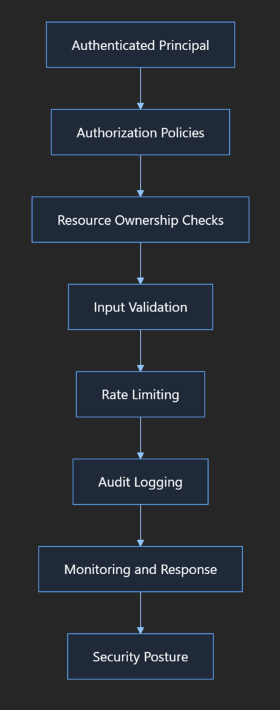
Production systems answer harder questions: what this caller may do, which tenant owns the resource, whether the token was issued for this API, how much traffic is acceptable, what must be audited, and what the failure response should reveal or hide. In modern ASP.NET Core applications, authentication is only one layer of a secure architecture. It supports the security model — it never replaces it.
Most of the security work that actually protects a company happens after the token is validated, in code that authentication never touches. That is the part teams routinely under-invest in, because the login flow demos well and the ownership check does not.
Authentication vs. the Decisions Around It
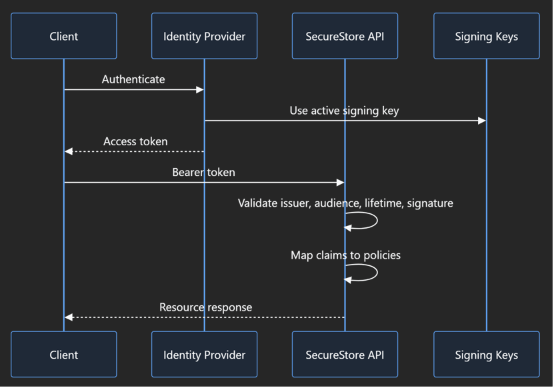
· Authentication: Validate who is calling: issuer, audience, lifetime, signing key, and token type.
· Authorization: Decide what the caller may do: read, rotate, export.
· Resource ownership: Verify tenant and ownership before loading sensitive data.
· Rate limiting: How much traffic is acceptable? — Partition limits by tenant and subject, separate rules for anonymous.
· Audit logging: What must be remembered? — Record security-relevant actions in an outbox-backed pipeline.
· Monitoring: How will failure be noticed? — Correlate OpenTelemetry traces, Serilog events, and security metrics.
Common Mistake
Treating a valid JWT as proof that the request is safe. A JWT says something about issuance and validation. It says nothing about the route parameter the caller just incremented by one.
The classic incident begins with a route like /api/vault-items/{id}. A developer adds [Authorize], queries by ID, returns the record, and moves on. The token is valid; the endpoint is protected. An attacker reads the same code differently: the route parameter is an input, the tenant claim is a constraint, the database row is a protected resource. When those concepts never meet in the code path, authentication is decorative.
A valid token is a question, not an answer.
Security Belongs in the Architecture
Teams often push too much security responsibility into middleware. Middleware can validate a token, enforce HTTPS, attach correlation IDs, and reject excessive traffic. It cannot decide whether a vault item belongs to tenant northwind, or whether a delegated support engineer may rotate a credential without seeing its plaintext.
Those decisions need domain knowledge, so they should live near the use case, not inside generic infrastructure. It belongs near the use case, expressed through policies, requirements, and resource checks that make insecure code hard to write.
Security in ASP.NET Core and .NET 9 applications is not a middleware. It is an architectural property designed across every layer of the system.
Design Decision
In SecureStore, middleware may reject a request early, but it never approves access to a specific resource. That decision belongs to the domain layer.
Defense in Depth Without Theater
Defense in depth is easy to reduce to a checklist: HTTPS, headers, JWT, and a few platform controls. Real depth means one failed control does not immediately become a breach. Real depth means one control can fail without the failure becoming a breach.
Suppose a token is stolen from a customer’s CI logs. Short lifetimes and strict audience validation shrink the window. Suppose a user guesses resource IDs. Ownership checks turn every guess into a 404. Suppose a script floods the bootstrap endpoint. Rate limiting absorbs it before the database notices. None of these controls is heroic alone. Together they change what failure costs.
Good security is usually boring: each control limits the damage when another one fails.
Risk and Mitigation in SecureStore
· Stolen token: Short lifetime, strict issuer/audience validation, rate limits, anomaly detection, IdP revocation.
· Cross-tenant access: Resource authorization, tenant-scoped queries, audit alerts.
· Credential leakage: Azure Key Vault, managed identity, no secrets in images, source control, or logs.
· Brute-force enumeration: Opaque IDs and ownership checks — Partitioned rate limiting and 404/403 discipline
· Silent security failure: Structured audit event pipeline — OpenTelemetry metrics and alerting on deny spikes
Secure software assumes failure. It survives by making each failure smaller.
Trust Boundaries Are Design Objects
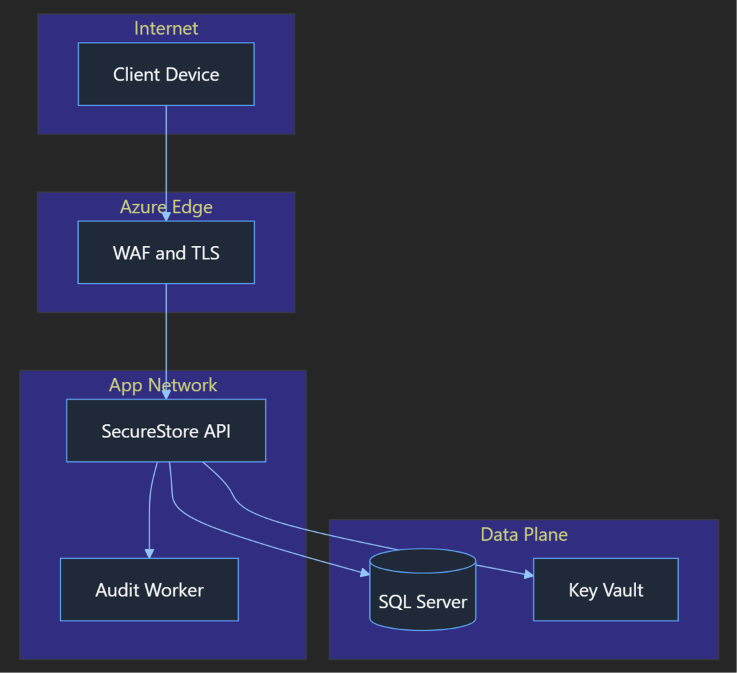
A trust boundary is not a diagram decoration. It is the place where one set of assumptions stops being valid.
The browser is not trusted. The edge is less trusted than the API. The identity provider is trusted for identity assertions, not for domain authorization. Key Vault is trusted for secret custody, not for deciding which tenant may export a credential. The logging system is trusted to receive events, not to preserve transactional truth unless the application hands it something durable.
Trust is not a feeling. It is an architectural decision you can point to in code.
Naming boundaries improves design review. “Can support call this endpoint?” becomes “which support role, for which tenant, for how long, and with access to which operation?” That is the level of detail the code needs.
Security Review
When I review a service, I draw the boundaries first and ask one question at each line: what stops being true here? If nobody on the team can answer for a given edge, that edge is where the next incident is already waiting.
Thinking Like an Attacker Changes the API
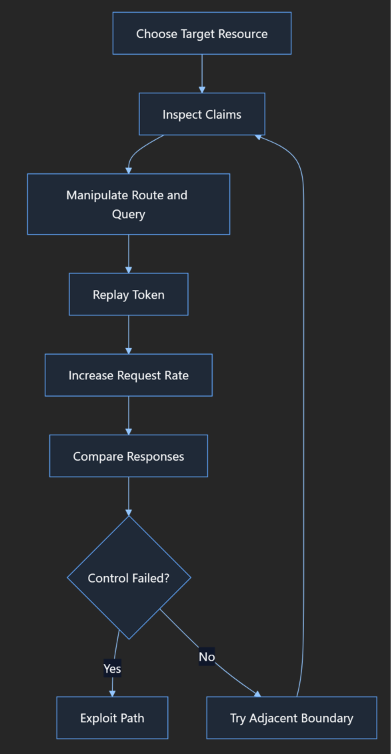
Attackers do not care that an endpoint passed QA. They look for assumptions the code does not enforce. They change GUIDs, replay old tokens, drop optional headers, compare response sizes, and exploit the gap between a 403 and a 404.
Imagine an attacker holding a valid low-privilege token for tenant A. They do not attack the login page; it works perfectly. They walk the vault-item route with IDs harvested from a shared export, watching for the response that returns 200 instead of 404. Every weak ownership check is a door. Authentication never even slowed them down.
Attackers often exploit assumptions that were never enforced in code.
If I Were Reviewing This Pull Request
I would not stop at RequireAuthorization(). I would ask where the tenant boundary is enforced, whether the query can ever return another tenant’s row, what gets audited on denial, and how the endpoint behaves when the token is valid but the resource belongs to someone else.
A Production JWT Configuration Is Narrow
A production API should accept a narrow set of tokens: the expected issuer, audience, lifetime, signing key, and token type.
The common failure mode is generosity: a second audience added for testing, issuer validation disabled for local dev and never restored, clock skew widened until it hides real problems. One mistake I keep seeing in enterprise reviews is the fallback issuer added during a bad deployment and never removed. It works, and now the API trusts two authorities for reasons no one remembers.
In ASP.NET Core APIs, a JWT proves identity — not authorization. Production systems must combine JWT authentication with policy-based authorization and resource ownership validation.
SecureStore keeps every validation rule explicit and disables MapInboundClaims so claim names stay honest. The dangerous defaults are the ones you forget you accepted.
Authentication registration (focused)
Production Tip
Keep development shortcuts out of the authentication options. If local development needs a different authority, change configuration. Never teach production code to accept weak tokens, because that code outlives the developer who wrote it.
The Pipeline Should Read Like a Security Manifest
The production pipeline should make the security order obvious: HTTPS, headers, rate limiting, authentication, authorization, and health checks should appear deliberately, not accidentally. The hosting style, Minimal APIs or controllers, is not the point. What matters is that pipeline order is intentional and a reviewer can see it without spelunking through partial classes.
Only a few lines carry the security meaning:
Program.cs (the order that matters)
Common Mistake
Putting UseAuthorization() before UseAuthentication() is the easy mistake; the compiler practically catches it. The dangerous one is mapping an endpoint with no policy because the group looked protected somewhere else in the file.
Pipeline order is not a style choice. It is the sequence in which your assumptions are allowed to fail.
Authorization Is a Product Model, Not a Role Check
Modern ASP.NET Core applications should avoid relying solely on roles. Fine-grained permissions and policy-based authorization provide a more scalable and secure authorization model. Coarse-grained roles are simple at first, but they become dangerous when the product model grows. “Administrator” can mean tenant admin, platform admin, billing admin, or temporary support access. If the API treats those as the same thing, the role has become a liability.
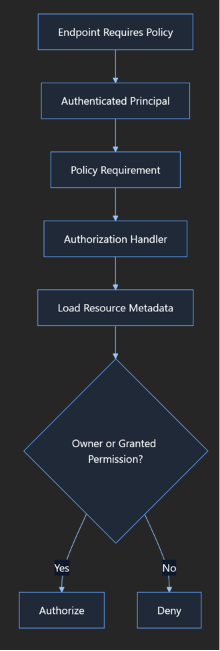
SecureStore separates roles, permissions, and resource ownership. Each operation is a named permission (vault_items.read, vault_items.rotate, vault_items.export) bound to a policy with a single requirement. Roles feed the decision; they never are the decision. Adding a capability means adding a permission, not widening a role.
The payoff shows up under pressure. During an incident, an engineer can ask which permission unlocks the risky operation and where it is evaluated, instead of reverse-engineering a dozen role names that accumulated across sales demos, migrations, and one-off enterprise contracts.
Design Decision
Modeling permissions as operations changes how features are estimated. A new export feature is not a controller method plus a query. It is an authorization model: who can export, whether export reveals plaintext, whether support can initiate it, and which audit event is mandatory.
Roles and Permissions in SecureStore
· Role: Grouping users by responsibility — Becomes a global bypass for resource rules
· Permission: Representing an operation — Can multiply without ownership semantics
· Policy: Binding permissions to API behavior — Unreadable if it embeds data access
· Resource handler: Evaluating a specific object — Slow if it loads too much data
Resource Ownership Is Where Many APIs Fail
Ownership checks are not glamorous, but they are what prevent multi-tenant APIs from leaking data across tenants.
SecureStore loads a small access snapshot, just the item ID, tenant ID, owner ID, and an administrator flag, before returning anything sensitive. The handler compares tenant, then ownership, then administrator permission, then explicit grants, and stays silent unless one of them succeeds. It never infers authorization from the mere fact that the database returned a row.
In a multi-tenant API, the most important line of code is the one that compares two tenant IDs.
Authorization handler (the decision, trimmed)
Engineering Note
The handler receives a resource snapshot, not an EF Core entity with half the database attached. Security checks should be explicit, cheap, and reviewable.
Endpoint Design Should Make Unsafe Paths Awkward
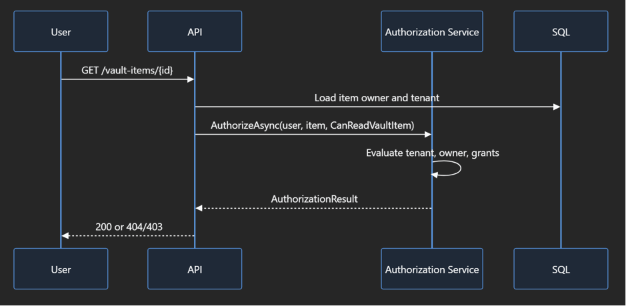
Secure endpoint design is about shaping the code so the natural path is the safe path. The vault-item endpoint never fetches the secret value first and authorizes later. It loads access metadata, authorizes against it, and only then materializes the encrypted payload.
A safer endpoint design makes the insecure order of operations hard to write.
Read the order of operations as a reviewer would. The sensitive read is the last thing that happens, and only after the decision is made. Cross-tenant reads return a uniform 404 so existence itself never leaks.
Endpoint authorization flow (focused)
If I Were Reviewing This Pull Request
I would look for the order of operations first. If sensitive data is materialized before authorization runs, I would request a redesign even when the current endpoint happens not to return it. Today’s safe shortcut is tomorrow’s disclosure bug.
Secrets Are Not Configuration Values
Configuration tells software how to behave. Secrets grant power. Treating both as ordinary strings is how production credentials end up in logs, container layers, and screenshots.
Production .NET applications should retrieve secrets from Azure Key Vault using Managed Identity, eliminating secrets from configuration files, Docker images, and source control. Developers never need production secrets, the pipeline never prints them, and the image never contains them.
Production Incident
A team I worked with leaked a database password not through an attack, but through a debug log line that serialized the entire configuration object on startup. The fix was one line. The exposure window was four months. Secrets and configuration sharing the same object is how that happens.
Configuration describes behavior. Secrets grant power. Never store them as if they were the same thing.
Secret management (Key Vault via managed identity)
Production Tip
A production operator should be able to rotate a secret without rebuilding the API container. If rotation requires a new image, the secret is coupled to your delivery pipeline in the wrong place, and rotation will not happen during the incident when it matters most.
HTTPS, HSTS, and Headers Are Necessary but Not Sufficient
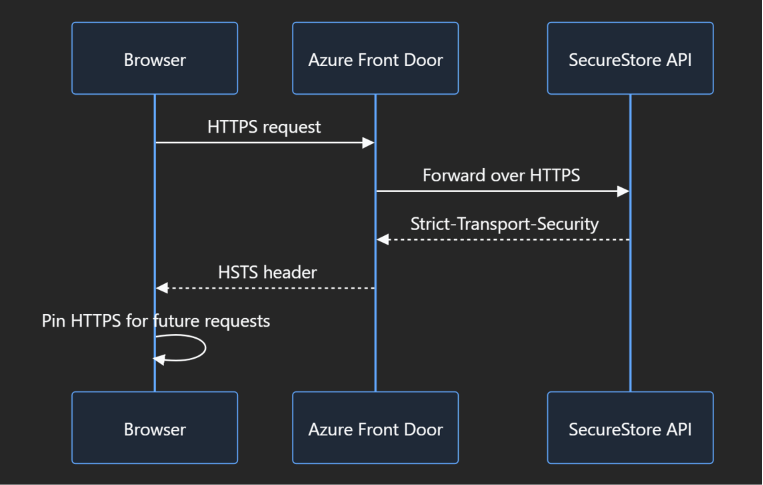
SecureStore terminates TLS at Azure Front Door, but the application still enforces HTTPS redirection and HSTS. Edge configuration can drift; the app should keep its own guarantees. Edge configuration drifts; the app should not care.
Security headers are applied centrally, with one caveat: API headers are not browser-application headers. The discipline matters more than the code.
Security headers (the ones that matter for an API)
Common Mistake
Copying browser security headers from a frontend project into an API without understanding their effect. Headers should express the actual client and threat model, not whatever the last template included.
Rate Limiting Is a Fairness and Security Control
Rate limiting almost always arrives after pain: a hammered login endpoint, a looping integration, a cost spike. The panic move is a single global limiter that throttles your largest customer the next morning.
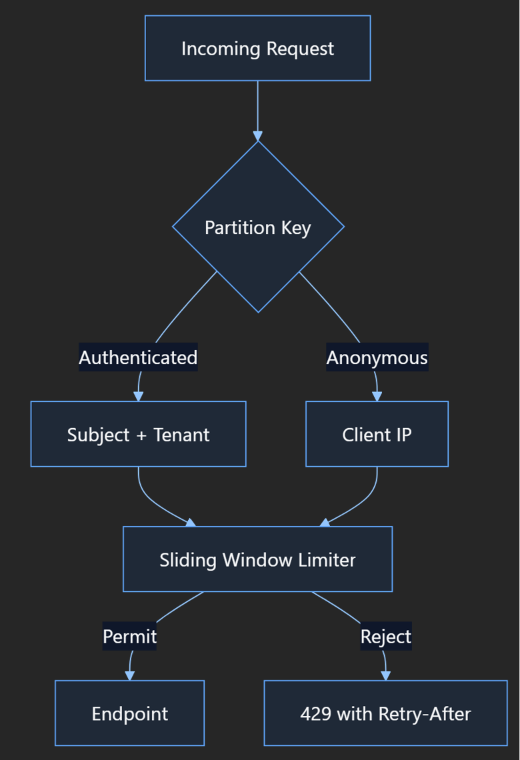
Good rate limiting is partitioned by whatever represents cost and risk. In SecureStore, authenticated traffic is keyed by tenant and subject, so one noisy integration cannot starve a neighbor; everyone else falls back to IP. That partition key is the whole design.
A poorly partitioned rate limiter can become an accidental denial-of-service against your own customers.
Rate limiting (the partition key is the design)
Audit Logging Is Not Application Logging
Application logs explain what the software did. Audit logs establish who is accountable. A request log is not enough to prove who exported a secret, which tenant was affected, and whether the operation succeeded after authorization.
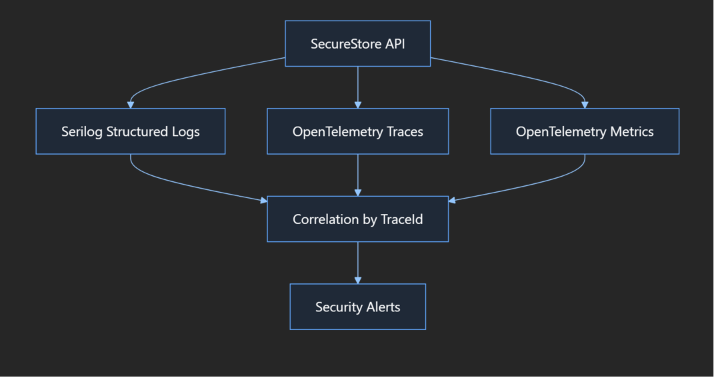
SecureStore writes audit events through an outbox table inside the same transaction as the sensitive change. If the transaction commits, the event exists; if it rolls back, so does the event. Every event carries the current trace ID, which later lets an investigator line it up with the exact distributed trace, and it never carries secret values.
Design Decision
We chose the transactional outbox over fire-and-forget logging specifically so accountability survives a crash between “do the thing” and “record the thing.” That gap is small, but during an incident it is exactly the gap an investigator falls into.
If your audit trail can be lost during a process crash, it is not reliable enough for incident response.
Audit write (trace-stamped, same transaction)
Engineering Note
Do not lean on log retention policy to satisfy audit requirements. Logs are operational evidence with an expiry date. Audit events are business and security evidence with a chain of custody.
Monitoring Turns Security From Hope Into Feedback
A control that nobody observes is weaker than it looks on the diagram. OpenTelemetry and Serilog provide end-to-end observability for modern ASP.NET Core applications by correlating traces, metrics, structured logs, and security events. A spike in 403s might be harmless after a deployment, or a full incident when it arrives alongside token validation failures and enumeration.
SecureStore emits security metrics straight from the authorization handlers and the rate limiter, with policy and endpoint dimensions, and traces database calls so a suspicious request can be followed from edge to API to SQL.
Security telemetry has to be designed before the incident. During an incident, you need policy names, endpoint names, tenant dimensions, and trace IDs already present in the data.
Production Incident
During one quiet weekend, denied-read metrics climbed slowly for a single subject across hundreds of resource IDs. No single request looked alarming. The aggregate did. Because the deny counter carried policy and endpoint dimensions, the on-call engineer found the enumeration in minutes instead of reading raw logs for hours.
You cannot defend what you cannot see, and you cannot see what you never instrumented.
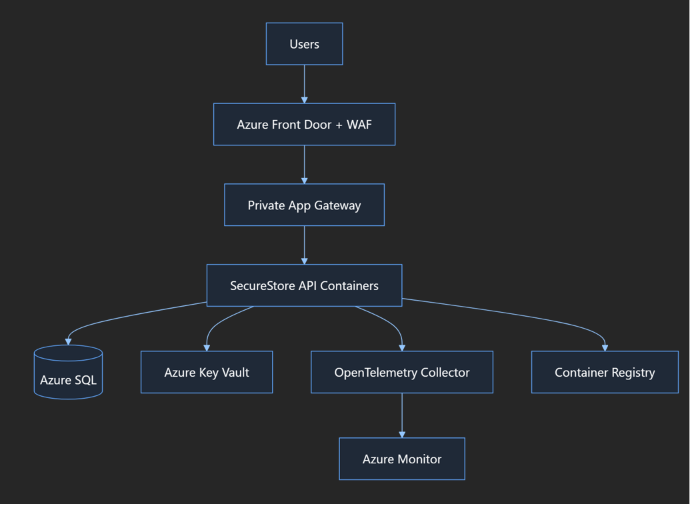
Docker, Microsoft Azure, and cloud-native infrastructure simplify deployment, but secure ASP.NET Core applications still depend on correct architecture, authorization, and operational practices.
Cloud platforms provide strong primitives, but they do not understand your business rules. Azure Front Door, WAF, managed identity, Key Vault, and private networking remove categories of risk, but they introduce new contracts: forwarded headers must be handled, health endpoints must not disclose dependencies, managed identity must be scoped, images must be rebuilt for base-image updates.
Security Review
Cloud primitives shift the location of risk; they do not delete it. Every time I move a control to the platform, I ask what new contract I just signed, and whether anyone on the team has actually read it.
Development vs. Production: Differences Worth Making Explicit
· Identity provider: Developer tenant or local test issuer — Dedicated authority with strict issuer and audience validation
· Secrets: User secrets or local secure store — Azure Key Vault through managed identity
· TLS: Local trusted development certificate — End-to-end HTTPS through Azure edge and app boundary
· Telemetry: Console and local collector — OpenTelemetry exporter, Azure Monitor, retained structured logs
· Rate limits: Relaxed for local workflows — Partitioned by tenant and subject with alerting
· Database access: Developer SQL instance — Azure SQL with least-privilege identity and network controls
A Production Checklist That Demands Evidence
A checklist cannot design a secure system. It can stop a tired engineer from skipping a known control at 6 p.m. on release day, which is when most of them get skipped. The trick is to make it evidence-driven: not “authorization reviewed,” but “every sensitive route maps to a named policy, and here is the test.”
SecureStore API Security Release Checklist
· JWT: Does production accept only the expected issuer and audience? — Startup validation and integration test
· Authorization: Does every sensitive endpoint require a policy? — Endpoint inventory and policy test
· Ownership: Does every resource endpoint enforce tenant scope? — Resource authorization tests
· Secrets: Are production secrets absent from source, image, and logs? — Repository scan and deployment review
· Transport: Are HTTPS, HSTS, and forwarded headers configured? — Environment smoke test
· Rate limiting: Are limits partitioned by tenant or subject? — Load test and metric validation
· Audit: Are sensitive actions written to durable audit events? — Outbox and worker test
· Monitoring: Do denied authz and rate limit events emit metrics? — Dashboard and alert review
· Errors: Do responses avoid leaking resource existence? — API contract test
Architecture Review
This checklist belongs to engineering, not to compliance. The moment it becomes a spreadsheet detached from code and telemetry, it stops finding defects and starts producing signatures.
A checklist is not a substitute for thinking. It is insurance against forgetting on the day you are too tired to think.
Common Architectural Mistakes
The same mistakes recur across mature ASP.NET Core systems because they are architecture mistakes disguised as implementation details. Global authorization by role, until a privileged role bypasses every tenant boundary. Trusting route data, until /tenants/{tenantId}/… becomes a lie detector with no detector. Logging too much on failure. Treating observability as optional. Making production secrets available to developers because deployment is inconvenient.
Common Mistake
Security reviews that focus only on middleware miss the domain entirely. The real exploit usually sails through middleware holding a perfectly valid token, and fails only if the domain model defends itself.
Most breaches are not clever. They are an ordinary request that no layer was responsible for refusing.
Where Security Actually Begins
Strip away the listings, the diagrams, and the Azure services, and one idea remains. Authentication gives the system a principal. That is all it does, and it does it well. Everything that decides whether the business survives production happens afterward.
SecureStore is not secure because it uses JWT. It is secure because authentication feeds a chain of deliberate choices, narrow token acceptance, resource ownership, policy-based authorization, secret custody, transport guarantees, rate control, durable audit, honest monitoring, and each link was placed by an engineer who asked what happens when this one fails.
Authentication is where API security begins. Architecture decides whether it survives production.
Build for that, and most incidents shrink from headlines into footnotes.
Key Takeaways
• Authentication proves identity.
• Authorization protects business rules.
• Resource ownership prevents cross-tenant access.
• Observability makes attacks visible.
• Architecture determines whether security survives production.
Frequently Asked Questions
Is JWT authentication enough to secure an ASP.NET Core API?
No. JWT authentication verifies the caller’s identity, but it does not determine whether that user is allowed to access a specific resource. A production-ready ASP.NET Core API also requires authorization policies, resource ownership checks, rate limiting, auditing, secure secret management, and continuous monitoring.
Why are ownership checks important in multi-tenant APIs?
Even with valid authentication, users should only access resources that belong to their tenant or have been explicitly shared with them.
Resource-based authorization prevents cross-tenant data exposure and is one of the most important security controls in enterprise ASP.NET Core applications.
What are the most common ASP.NET Core API security mistakes?
Some of the most common mistakes include:
Trusting JWT authentication alone
Missing resource ownership validation
Overusing administrator roles
Weak JWT validation settings
Storing secrets in configuration files
Missing audit logging
Insufficient monitoring and telemetry
No rate limiting for public endpoints
These issues frequently appear in production systems despite successful authentication.
👏 Enjoyed this article?
If this topic is useful to you, the next article in the series will go deeper into JWT mistakes I commonly see in ASP.NET Core APIs.
📚 Modern .NET Engineering Series
This article is part of an ongoing series about building production-ready .NET applications.
➡️Part 2 — JWT Done Right: Common Mistakes Every ASP.NET Core Developer Makes